Quirks of VAR_IN_OUT CONSTANT in TwinCAT
An exploration of how the TwinCAT compiler handles VAR_IN_OUT CONSTANT parameters, specifically with string literals and temporary variables.
At first glance, VAR_IN_OUT CONSTANT seems to simply prevent writing to a variable. In reality, its behavior is more subtle.
Any VAR_IN_OUT is a reference to a variable from an outer context. However, for a VAR_IN_OUT CONSTANT of a string type, it is possible to pass a string literal directly into a method. This does not work for other types (numbers, etc.).
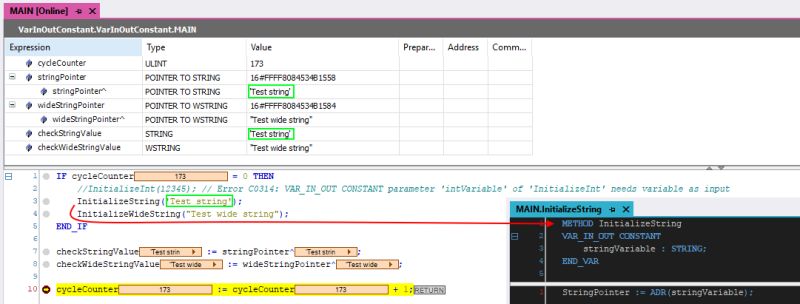
I assumed that the compiler creates a temporary variable for the literal and destroys it after the method call. However, experiments showed otherwise: the automatic variable persists, and the data at that address remains accessible.
This means the compiler already implements automatic variable creation for string literals. I think this does not work for other short types because such types can be passed using VAR_INPUT without any performance loss.
It would be nice to have similar behavior for structures and arrays, and support the same functionality for ANY.
The illustration below clarifies the scenario.
#TwinCAT #CoDeSys #StructuredText #OOP #IndustrialAutomation